
Texas County Probate Division
Probate in Texas County is handled by the Probate Division of the Circuit Court through the Circuit Clerk. The State Court Structure Map confirms that Missouri uses Circuit Courts as the primary trial courts and that the probate function is part of that Circuit Court structure. Texas County is in the 25th Judicial Circuit with Maries, Phelps, and Pulaski counties, and the local Circuit Clerk maintains court records for civil, criminal, traffic, juvenile, probate, jury, and accounting divisions.
Probate records may include decedent estates, wills, letters testamentary, letters of administration, refusals of letters, inventories, creditor claims, notices, orders, accountings, final settlements, guardianships, conservatorships, minor estates, and trust-related matters assigned to probate. The court file can show who filed the matter, who was appointed, what notices were issued, whether claims were filed, and how the estate or protected-person matter moved through court.
The local access path is direct. Search public case data online when possible, then use the Circuit Clerk for certified copies, older estate files, filings that are not visible remotely, and questions about restricted access. Probate should not be routed to the Recorder of Deeds unless the task is a separate recorded-document issue, such as a deed connected to estate property.
Probate Division of the Circuit Court
Texas County Circuit Clerk
519 North Grand Avenue, Suite 202
Houston, MO 65483
417-967-3742
Fax: 417-967-4220
Monday-Friday, 8:00 AM-4:30 PM
Probate Terms Defined
Probate filings use terms that identify both the person involved and the role assigned by the court. A short glossary helps separate estate cases from guardianship and conservatorship cases, which can have different privacy limits and different records.
- Testator
- A person who made a will before death.
- Executor
- The person named in a will to carry out estate duties, often called a personal representative after appointment.
- Intestate
- Dying without a valid will, so estate distribution follows Missouri law and court procedure.
- Guardianship
- A court case about care and personal decisions for a minor or incapacitated person.
- Conservatorship
- A court case about managing money or property for a protected person.
- Letters
- A probate authority document showing who may act for an estate, guardianship, or conservatorship.
Search Texas County Probate Records
Public probate records may be searchable through Missouri Case.net by party or decedent name, case number, filing date, and court or circuit filters when the matter is public and entered into the system. The county's Circuit Clerk page directs case searchers to Case.net and says 25th Judicial Circuit search results are real time after the clerk enters the data. Older estate files, certified copies, and restricted probate questions still go through the Circuit Clerk.
For a mailed probate-record request, include the decedent or protected-person name, approximate filing year, known case number, and a clear copy request. If the request involves letters, a will, an inventory, a final settlement, or a guardianship order, name the document as specifically as possible. This helps the clerk distinguish a probate copy request from a general case search.
- Search Case.net with the decedent, protected person, petitioner, or case number.
- Choose the 25th Judicial Circuit when the filing is a Texas County probate matter.
- Review the case type, filing date, parties, docket entries, hearings, and orders that are public.
- Write down the case number before calling or mailing the Circuit Clerk for copies.
- Ask the clerk about certified copies, restricted documents, or older estate files not visible online.
The Probate Division also connects to federal bankruptcy only when a separate federal bankruptcy case exists. The Western District of Missouri bankruptcy court source is separate from Texas County probate records.
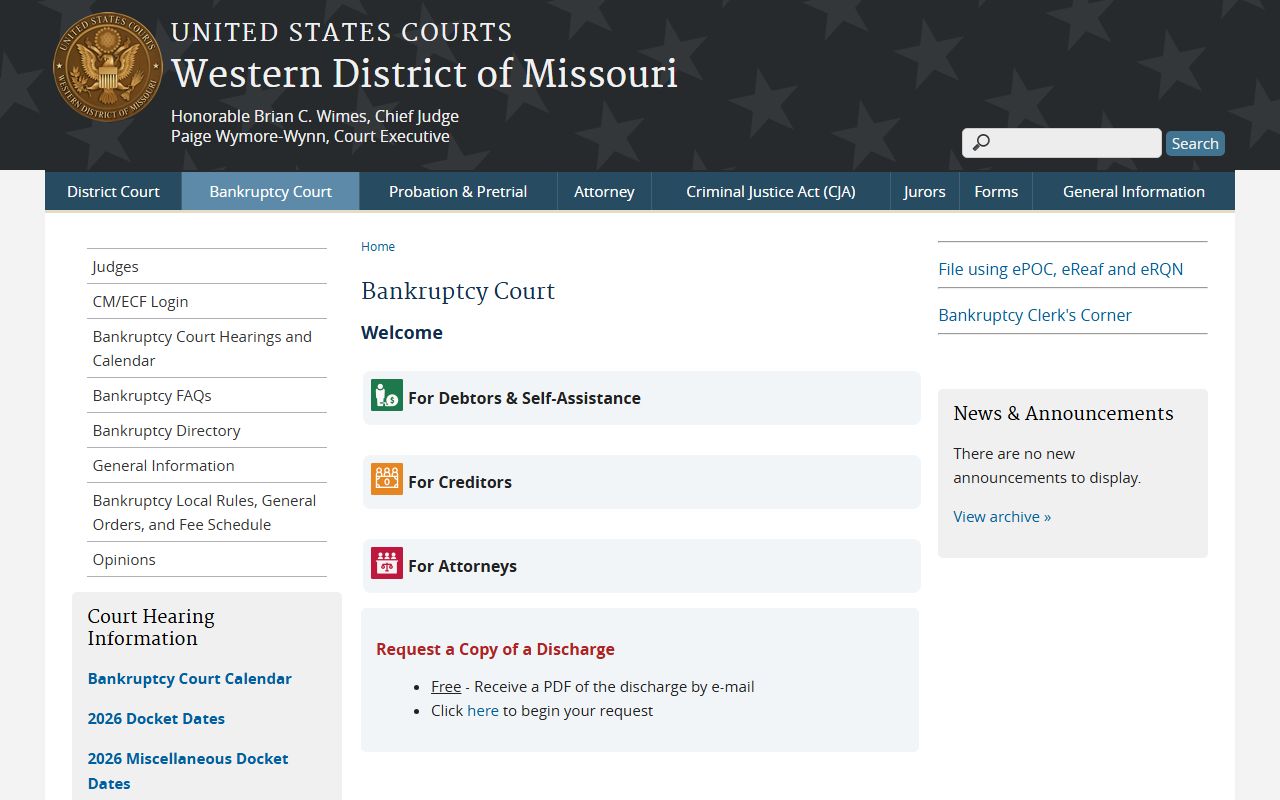
That federal source helps mark the boundary between county probate estate records and bankruptcy cases in federal court.
Texas County Probate Record Fields
A public probate file can show the case number, filing date, court division, case type, decedent or protected-person name, applicant, petitioner, attorney, appointed personal representative, administrator, guardian, or conservator. Estate records may also show whether a will was filed, the date of the will if public, letters issued, inventories, appraisals, creditor notices, claims, accountings, final settlements, orders, and hearing entries.
Guardianship and conservatorship files may look different from estate files. They can focus on petitions, appointments, annual accountings, medical or capacity findings, bond entries, property management, and later modification or termination orders. Those cases can involve living protected persons, so the public version may be narrower than a decedent-estate docket.
| Field | What It Shows |
|---|---|
| Case number and filing date | The court identifier and when the probate matter opened. |
| Decedent or protected person | The estate subject, minor, or adult protected by the case. |
| Petitioner or applicant | The person asking the court to open or act in the probate matter. |
| Representative or fiduciary | The personal representative, administrator, guardian, or conservator appointed by the court. |
| Inventory and claims | Assets, creditor notices, claims, or accounting entries when public. |
| Orders and closing documents | Judicial decisions, settlements, discharge, or case-closing entries. |
Small Estate Probate
Missouri small estates are governed by RSMo 473.097. The research states that the statute allows a simplified small-estate procedure when the value of the entire estate, less liens, debts, and encumbrances, does not exceed $40,000 and 30 days have elapsed since death, with other statutory conditions. That does not mean every estate under that amount qualifies automatically. The court still requires proper filings.
The small-estate path is often used when a full estate administration is not needed, but the filing still creates a probate court record. A requester reviewing Texas County probate records should watch for affidavits, refusals of letters, notices, property descriptions, creditor issues, and orders tied to the simplified process.
The Missouri small-estate statute source is the cited legal basis for the simplified estate procedure.
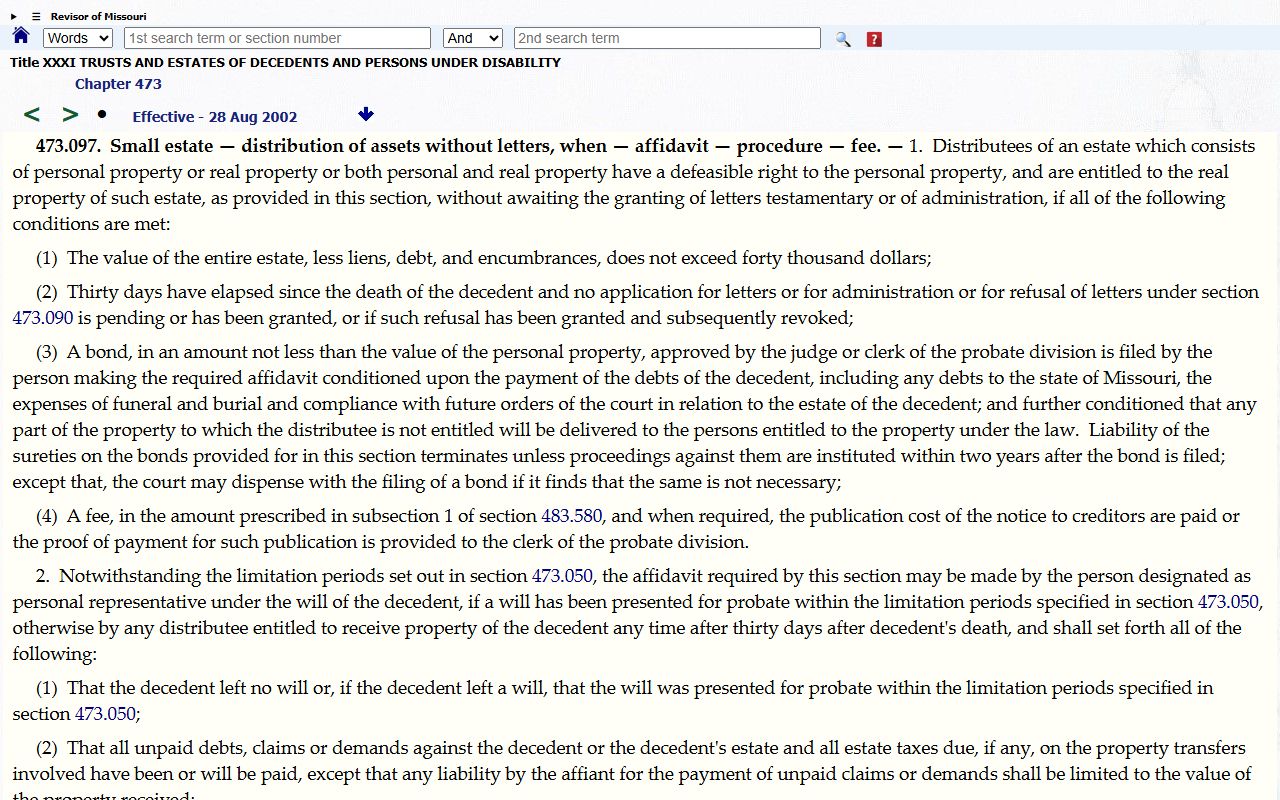
That statute image supports the Texas County probate discussion where small-estate filings appear in the court record.
Probate Filing Fees
The official Texas County sources captured for probate did not publish a county probate fee schedule. Because Phase B forbids invented fees, the probate page should show fee status rather than dollar amounts that were not documented. Call the Circuit Clerk before mailing a filing, copy request, or certification request, especially when the request involves a certified document or older file retrieval.
Probate costs can differ by filing type, copy type, and whether publication, service, bond, or certification is involved. A small-estate affidavit, a full estate administration, a guardianship, and a conservatorship are not interchangeable filings. The Circuit Clerk is the documented local office for checking which fee applies before a packet is submitted.
| Probate Item | Published Amount | Where to Verify |
|---|---|---|
| Estate opening or probate application | Not located in official Texas County sources | Texas County Circuit Clerk |
| Letters testamentary or administration | Not located in official Texas County sources | Texas County Circuit Clerk |
| Certified probate copy | Not located in official Texas County sources | Texas County Circuit Clerk |
| Guardianship or conservatorship filing | Not located in official Texas County sources | Texas County Circuit Clerk |
Fee caution: Do not rely on private fee summaries for Texas County probate filings unless the Circuit Clerk confirms the amount and payment method.
Restricted Probate Records
Some probate records are public, but probate files can contain private material. Medical information, minor names, protected-person details, addresses, financial account data, and some guardianship or conservatorship materials may be redacted or restricted. If a case involves a minor or incapacitated person, the public record may show only limited docket information. A sealed probate file or sealed document is not available through ordinary remote access.
For copies, mail requests should include the decedent or protected-person name, approximate filing date, case number if known, and whether plain or certified copies are requested. In-person visitors should use the Circuit Clerk office at the Justice Center. The county's Jury Commission source says the Justice Center screens entrants and bars cell phones and weapons, so records visitors should plan around those rules.
Federal bankruptcy records use a different portal. The Western District of Missouri Bankruptcy CM/ECF source is not the Texas County probate docket.
That login source is included because bankruptcy can be confused with estate administration, but it is a federal case system outside the county probate division.
Appeals from probate orders follow Missouri's appellate system, not a separate county probate appeal office. The research identifies the Missouri Court of Appeals as the appellate court, while Texas County probate filings remain in the Circuit Court record system unless an appeal or separate federal case is opened.
Note: Circuit Clerk staff can explain filing and copy procedures, but they cannot decide whether a probate filing is legally sufficient.