
Texas County Arrest Records and Court Charges
Texas County arrest records start with the agency that made the arrest or booked the person into custody. The Sheriff's Office and jail handle custody questions, warrant service, transport, and non-confidential law-enforcement record requests. The official sheriff page confirms that the Texas County Sheriff serves criminal processes such as warrants and subpoenas, transports prisoners to state and federal facilities, and extradites fugitives back to Texas County for prosecution.
Court charges after arrest begin when the Prosecuting Attorney files a complaint, information, indictment, or related charging document with the Circuit Court. That filing creates the court charge record, which is tracked through Case.net and the Circuit Clerk when public. The charge record may show offense descriptions, statute references, filing dates, prosecutor action, bond, first appearance, plea, amendment, dismissal, and disposition. Full case outcomes belong in Criminal Court Records, while jail custody questions belong in Inmate Records.
Find Texas County Arrest Records
The county research did not locate an official Texas County mugshot site or public online jail roster. For local custody or booking information, the practical fallback is the Sheriff's Office and jail. For the court charges filed after an arrest, use Missouri Case.net and narrow to the 25th Judicial Circuit when possible. Texas County's Circuit Clerk page says 25th Circuit entries are real-time after clerk entry, while all participating-courts searches can lag by up to three hours.
- For custody or booking status, call or visit the Texas County Sheriff's Office and jail.
- For filed court charges, open Missouri Case.net and search the 25th Judicial Circuit.
- Search by defendant name, case number, ticket number, or filing date when available.
- Open the case and review the charge list, docket entries, bond, plea, disposition, and sentencing fields.
- Ask the Circuit Clerk for certified copies or records that are not available through the public view.
A Case.net charge entry is not the same as a statewide criminal-history report. It is a public court case entry when the case is open to public view. Sealed, expunged, juvenile, confidential victim, protected-address, mental-health, and some investigative records may not appear. Public-record requests for sheriff records can be made to the Sheriff's Office, but law-enforcement records may be closed when they are investigative, juvenile, sealed, unserved, or otherwise restricted by law.
How Charges Get Filed After an Arrest: Complaint, Information, and Indictment
An arrest does not always mean every alleged offense will become a filed court charge. The Prosecuting Attorney reviews the report, available facts, and jurisdiction, then decides whether to file state-law charges. The official Texas County Prosecuting Attorney page says the office prosecutes crimes violating state law from traffic tickets to murder, has exclusive jurisdiction over felony crimes in Texas County, and prosecutes misdemeanors in unincorporated areas. It does not prosecute local ordinances.
| Complaint | Information | Indictment | |
|---|---|---|---|
| Filed by | Prosecutor or law-enforcement supported filing, depending on case path. | Prosecutor. | Grand jury. |
| Common use | Initial criminal filing or lower-level charge path. | Many prosecutor-filed felony or misdemeanor charges. | Serious felony path when a grand jury returns charges. |
| Record effect | Creates a charge entry and docket history. | States formal charges and case level. | Creates formal charges based on grand-jury action. |
The assigned image from the U.S. Attorney's Office for the Western District of Missouri reflects the separate federal prosecution channel. Federal charges do not appear as Texas County Circuit Court charges in Case.net.
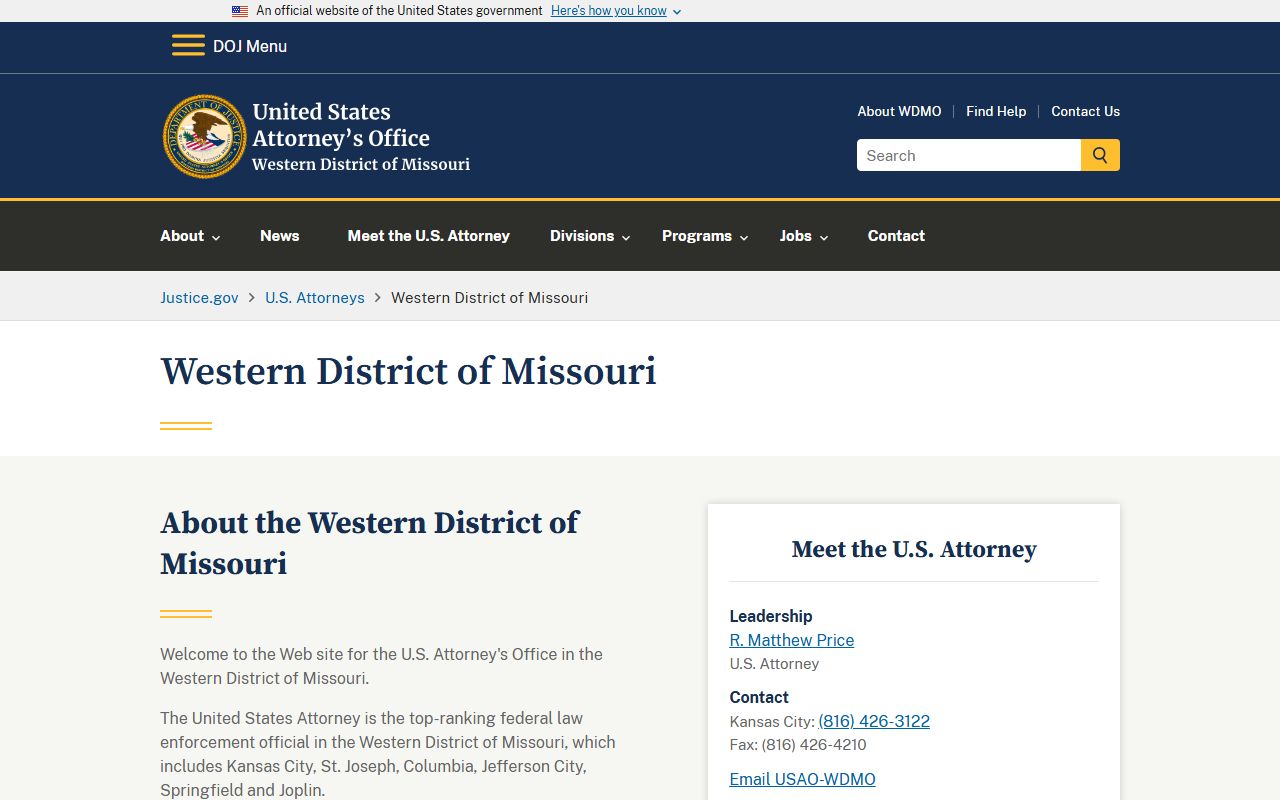
Federal and state charge records can involve the same conduct in rare cases, but they are searched in different systems and handled by different prosecutors.
Charge Status and What It Means
Charge status can change more than once. A Texas County arrest may produce no filed charge, one filed charge, or several filed charges. A filed charge may later be amended to a different statute, reduced to a lower severity level, dismissed, or resolved by plea or trial. The current status should be read with the docket date and disposition. A charge listed near the start of a case may not be the final outcome.
| Status | What It Means |
|---|---|
| Pending | The charge remains open and has not reached final disposition. |
| Amended | The prosecutor or court record changed the charge description, statute, count, or other filed detail. |
| Reduced | The charge was changed to a lower offense or severity level as part of case handling. |
| Dismissed | The charge was ended by court action; check whether the entry says with or without prejudice. |
| Disposed | The charge has reached a recorded result such as plea, finding, dismissal, or sentence. |
Terms can be technical. A docket is the chronological list of filings and court events. A disposition is how a charge ended. Bond is a release condition or money posted to help ensure appearance. A capias or bench warrant is a court-issued warrant, often tied to failure to appear.
Charges vs. Convictions
Being charged is not the same as being convicted. Texas County arrest records may show that a person was taken into custody. Court charge records may show that the prosecutor filed one or more charges. A conviction appears only when the court record shows the legal result required for guilt, such as a guilty plea or finding. A charge can remain public even if it was later dismissed, unless a sealing or expungement order restricts access.
| Charge | Conviction | |
|---|---|---|
| Stage | Accusation filed in court. | Final result after plea, verdict, or finding. |
| Record location | Charging document, charge list, and docket entries. | Disposition, judgment, sentence, and compliance entries. |
| Risk when reading | May be dropped, changed, or dismissed. | May still need context, such as sentence terms or later expungement. |
For a full case-file reading, use Texas County criminal court records. The arrest-to-charge view is narrower because it focuses on the transition from sheriff or police action to prosecutor filing.
Sealed vs. Expunged Records
Missouri law closes some arrest and charge information from ordinary public view. Juvenile court records are generally confidential under RSMo 211.321. Expungement is addressed in the Missouri chapter range that includes RSMo 610.140. Eligibility depends on offense type, time, criminal history, sentence completion, fine and restitution status, and other statutory terms.
| Sealed | Expunged | |
|---|---|---|
| Public visibility | Closed from ordinary public access by law or court order. | Closed after a qualifying petition and order. |
| Record effect | The record may still exist for authorized court or agency use. | Public access is restricted, though some agencies may retain statutory access. |
| Who decides | Statute, court rule, or judge. | Judge after petition, notice, and eligibility review. |
The Missouri Revisor chapter range is an assigned source for charge records. The official statutory source is the right reference for closure and expungement rules, not a private record site.
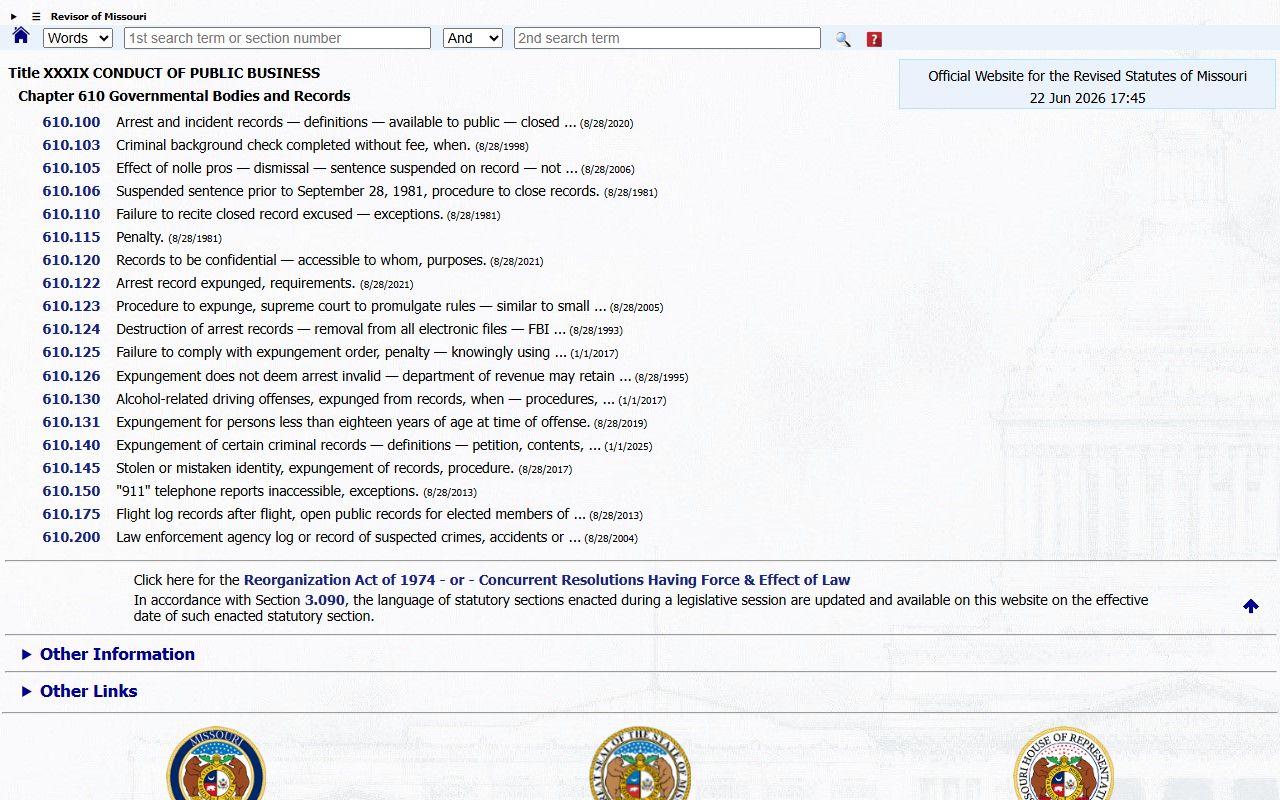
Statutory closure rules explain why some arrest records or charge records may disappear from a public search even though an agency or court still retains a file.
Charge Codes and Severity Levels
Charge codes tie a filed accusation to a Missouri statute or ordinance. A single arrest can produce several separate counts, and each count can have its own severity, bond setting, plea, dismissal, or sentence. Texas County felony charges are within the county prosecutor's exclusive jurisdiction. Misdemeanors in unincorporated areas may also be prosecuted by that office. City ordinance violations are different because the county prosecutor page says local ordinances are not prosecuted by the Prosecuting Attorney.
A charge line should be read with its docket history. Early charge text may reflect the first filing, while later entries may show an amendment or reduction. A disposition attached to one count does not always resolve every count. When the court record is unclear, the Circuit Clerk can provide copy and access information, but legal interpretation should come from an attorney.
Statewide Charge and Criminal History Lookups
Missouri Case.net is the researched statewide court case portal for public circuit-court records. It is not a county-built Texas County arrest database. The Missouri Department of Corrections offender search is useful for people under DOC supervision, but it does not replace Texas County jail booking information. VINELink is a custody-status and notification system, not a warrant-clearing or court-charge database. The MSHP sex offender registry can be searched for registered sex offenders, but it is a separate registry with its own limits.
The best access chain depends on the question. Use the Sheriff for custody and booking questions. Use Case.net for filed charges and court status. Use the Circuit Clerk for certified court copies. Use the Prosecuting Attorney's Office for prosecution-office records only when appropriate, keeping in mind that investigation and victim-related information may be closed.
Background Check Considerations
Arrest and charge lookups need context. An arrest may not lead to a filed charge. A filed charge may not lead to a conviction. A dismissed charge may remain visible unless sealed or expunged. Public online searches can miss nonpublic records and can also show records that need clerk confirmation. Anyone using arrest records or court charges for employment, credit, housing, insurance, tenant screening, or another regulated purpose should use a legally compliant consumer-reporting process.
Important: A public charge lookup is record access, not a regulated employment, tenant, credit, or insurance background report.
Restricted Charge Records in Texas County
Restricted charge records can include juvenile matters, sealed cases, expunged cases, confidential victim information, protected addresses, medical or mental-health material, minor names, and records tied to ongoing investigations. Unserved warrants and some law-enforcement records may be closed. A public Case.net result may omit the document image or withhold part of a filing if the record contains confidential data.
The Circuit Clerk is the correct office for court-file copies, while the Sheriff is the local office for non-confidential booking or law-enforcement record requests. The Prosecuting Attorney handles state-law prosecution but may not release investigative, victim-service, or prosecution-work-product material. For city ordinance arrests or citations, contact the municipal court or city named on the citation because the county prosecutor does not handle local ordinances.
Note: No official Texas County mugshot database or public jail-roster search was located in the reviewed official sources.